
Lions of Tanzania
Where Africa’s King still roams free
The Lion capital of Africa –
Where to see Lions, How many there are and What makes Tanzania so special
There are few moments on an African safari as powerful as seeing a lion in the wild.
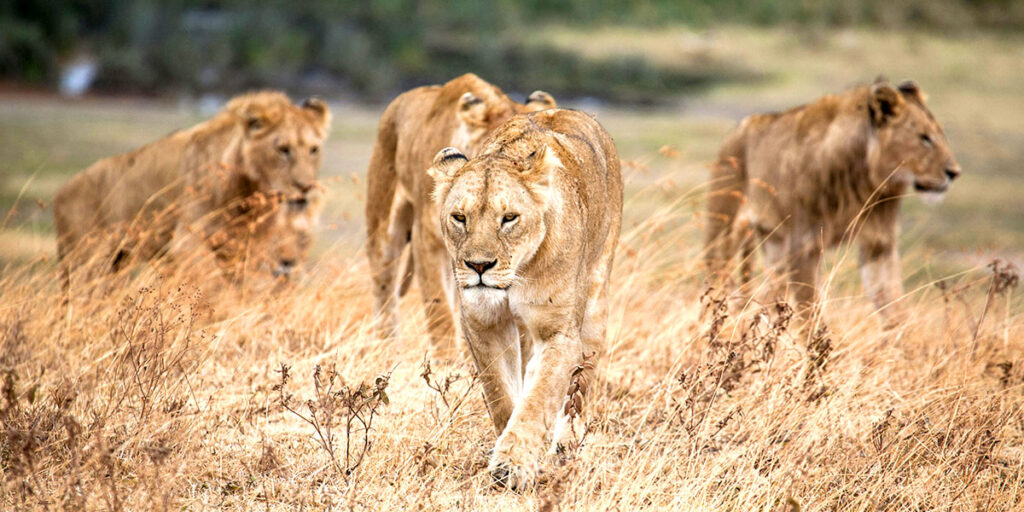
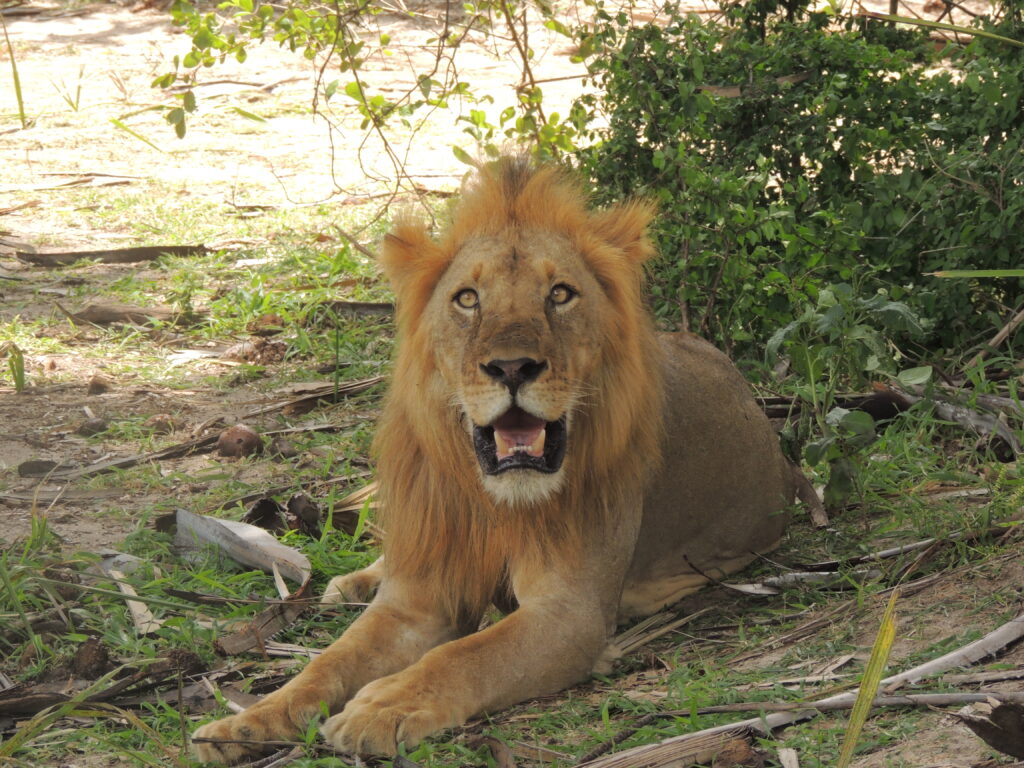
You may spot a male resting beneath an acacia tree, his mane moving gently in the afternoon breeze. A lioness may disappear silently into the tall grass, followed by a procession of curious cubs. Or, if you are incredibly lucky, you may witness an entire pride moving together across the endless plains of Tanzania.
This is not a zoo. There are no fences between you and the wilderness.
This is Tanzania – one of the most important remaining strongholds for African lions.
Tanzania is believed to support the largest lion population of any country in Africa, with scientific assessments estimating more than 8,000 lions nationally. However, this figure should be treated as an estimate rather than an exact census, because lions live across enormous protected landscapes and population monitoring methods vary between regions.
For wildlife lovers, that makes Tanzania extraordinary.
But where exactly are Tanzania’s lions found? Why are some areas particularly important? And what makes the lions of the Serengeti, Ruaha, Tarangire and Ngorongoro so fascinating?
Let’s take a closer look.
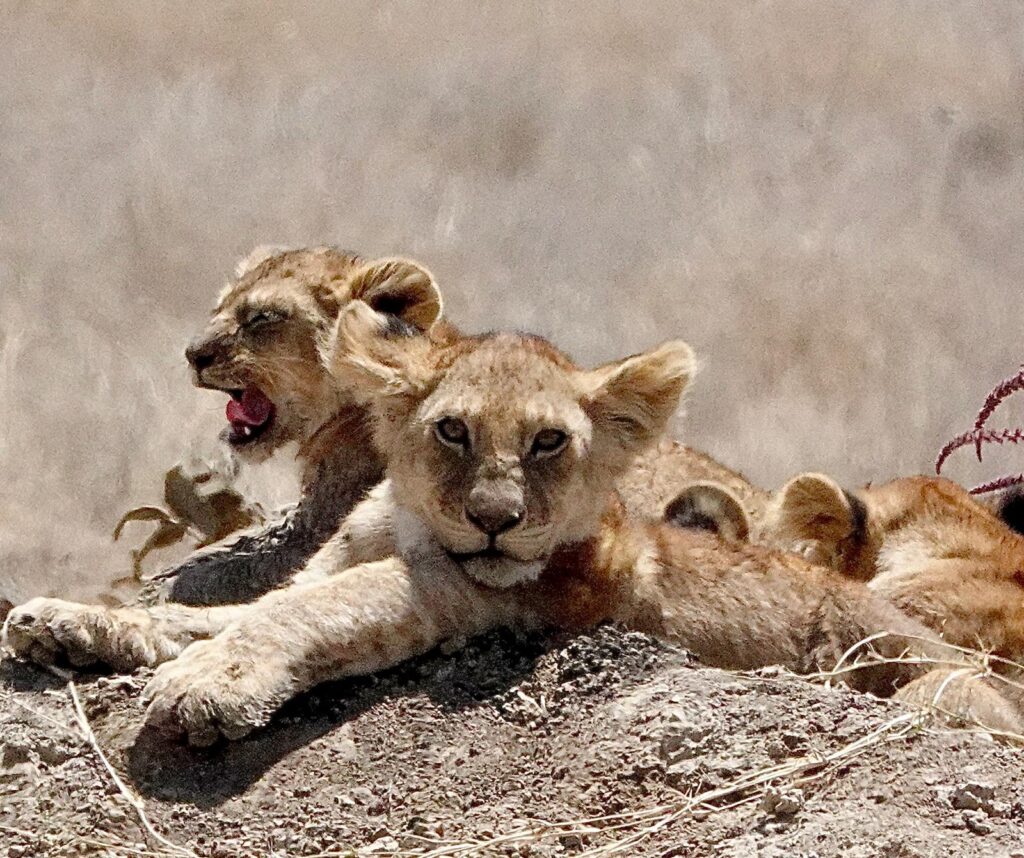
Why Tanzania is so important for Lions
The African lion (Panthera leo) has disappeared from much of its historic range. Today, viable populations survive mainly in protected areas and connected conservation landscapes where sufficient prey, habitat and protection remain.
Tanzania is exceptional because it still contains several enormous ecosystems capable of supporting lions at landscape scale.
From the Serengeti-Mara ecosystem in northern Tanzania to the vast Ruaha-Rungwa landscape in the south-central part of the country and the Selous-Nyerere ecosystem in the east, lions still move through thousands of square kilometres of relatively wild habitat.
A 2023 scientific assessment found that Tanzania had by far the largest number of lions among the African countries assessed, with an estimate of more than 8,000 individuals. The same study highlighted the enormous size of Tanzania’s remaining lion range.
But numbers alone do not tell the whole story.
The real strength of Tanzania’s lion populations lies in the size and connectivity of its ecosystems.
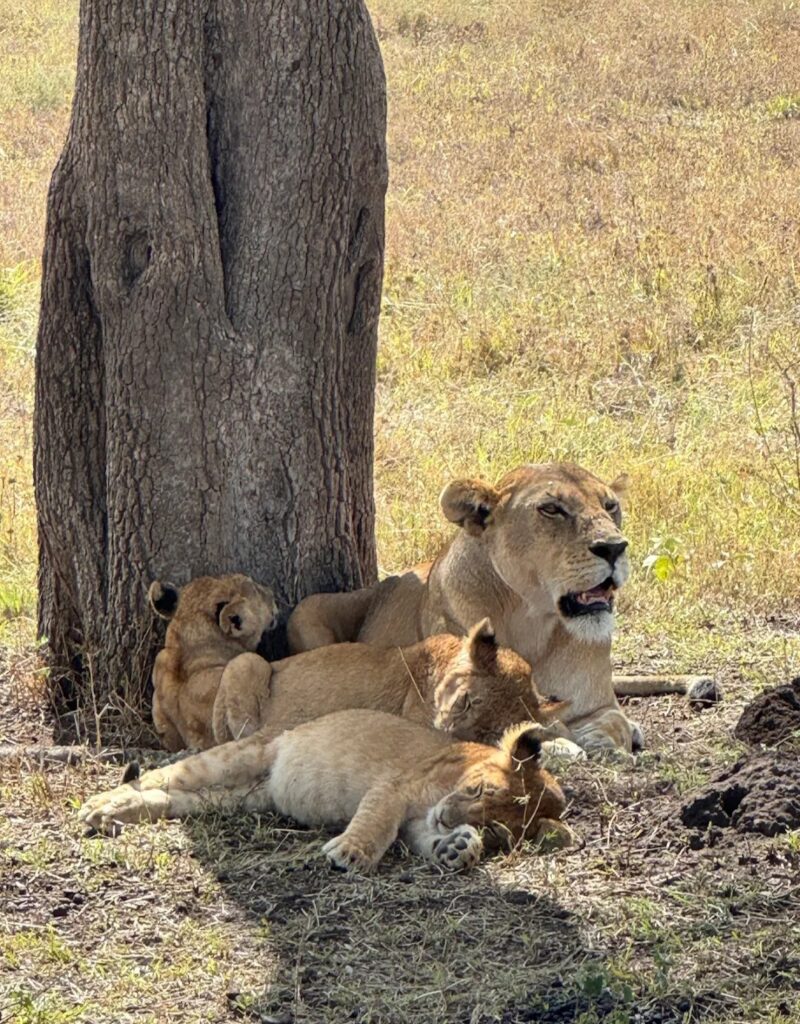
The Serengeti – Tanzania's Legendary Lion Country
When most people imagine an African lion, they probably imagine the Serengeti.
And for good reason.
The Serengeti ecosystem is one of the most famous wildlife landscapes on Earth. Its enormous grasslands support one of the world’s greatest concentrations of large herbivores, including the annual migration of approximately 1.3 million wildebeest, together with large numbers of zebra and gazelle.
Where there is abundant prey, there can be abundant predators.
The Serengeti has been home to long-running lion research for decades. Since the 1960s, researchers have monitored lion populations, movements and social behaviour in the ecosystem.
And this is what makes a Serengeti lion encounter so special: you are not simply seeing an individual animal.
You are observing a complex social society.
Lions are the most social of the big cats
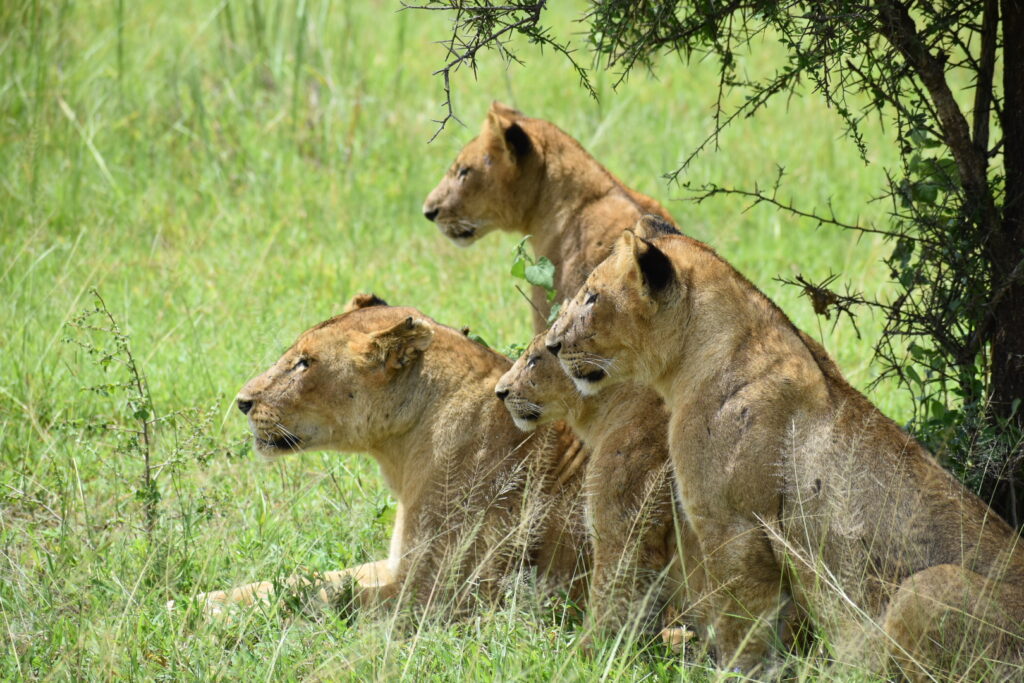
Unlike leopards and most other large cats, lions live in social groups known as prides.
A pride generally consists of related females, their offspring and one or more adult males or male coalitions. In prey-rich ecosystems such as the Serengeti, prides can become considerably larger than in many other parts of Africa.
Lion Landscapes notes that prides in the Serengeti typically number around 13 lions, although group size varies considerably.
The females are usually the heart of the pride.
Female cubs often remain within their mother’s social group, creating generations of related females living together. Young males eventually leave their natal pride and may form coalitions with other males.
This social structure is one of the reasons lions are so fascinating to watch.
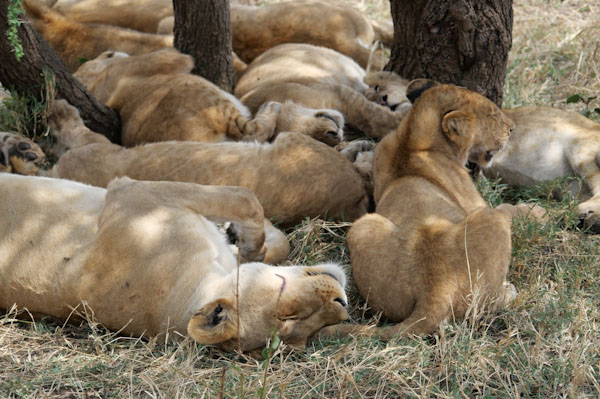
The Great Migration and the Lions of the Serengeti
Few wildlife events on Earth can compare with the Great Wildebeest Migration.
And wherever enormous herds move, predators are never far away.
Lions do not migrate in the same way as wildebeest. Instead, they respond to changing prey availability across the ecosystem.
The movement of millions of herbivores therefore creates a constantly changing predator-prey landscape.
Research has shown that the relationship between Serengeti lions and their prey is far more complex than simply “more prey equals more lions”. The social behaviour of prey species, their group size and seasonal movements all influence how lions hunt and feed.
This is one reason why every safari day in the Serengeti can be different.
One morning you may find a lioness alone.
Later that day, you may encounter an entire pride resting beside a kopje.
And somewhere else, a coalition of males may be patrolling its territory.
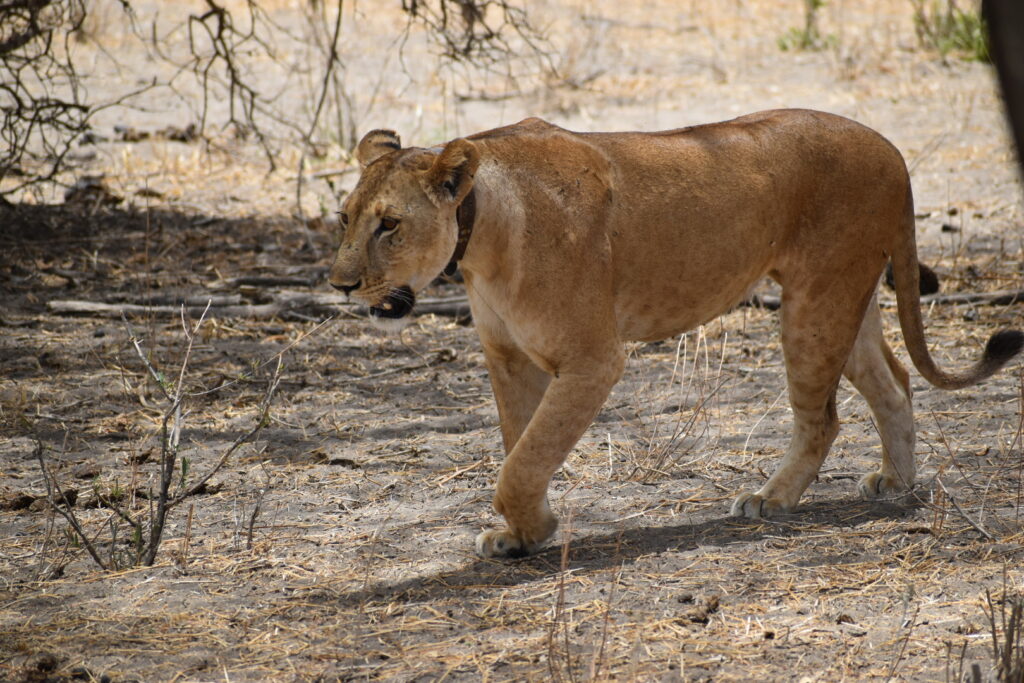
Ruaha – One of Africa's Great Lion Strongholds
If the Serengeti is Tanzania’s most famous lion landscape, Ruaha and the wider Ruaha-Rungwa ecosystem may be one of its most important.
The scale is enormous.
The Ruaha-Rungwa conservation landscape covers more than 50,000 km² and supports one of the world’s largest remaining lion populations.
Research in the region has revealed particularly impressive lion densities in productive areas of Ruaha National Park.
A camera-trap study found the highest measured lion density in its core Ruaha study area at approximately 6 adult and sub-adult lions per 100 km², with similarly important populations in surrounding community-managed landscapes.
Another study using call-back surveys estimated 286 lions in a 3 km² sampled area during the wet season, compared with 196 during the dry-season survey.
These numbers demonstrate something important:
Ruaha is not simply a place where lions can be seen. It is a genuine lion stronghold.
And Ruaha’s lions have developed a reputation for being formidable hunters.
The ecosystem supports large numbers of buffalo, which are particularly important prey for lions in this landscape. Researchers have highlighted the importance of buffalo as a key component of lion ecology in Ruaha-Rungwa.
This can produce dramatic predator-prey encounters.
A pride of lions confronting a large buffalo herd is one of the rawest expressions of the African wilderness.
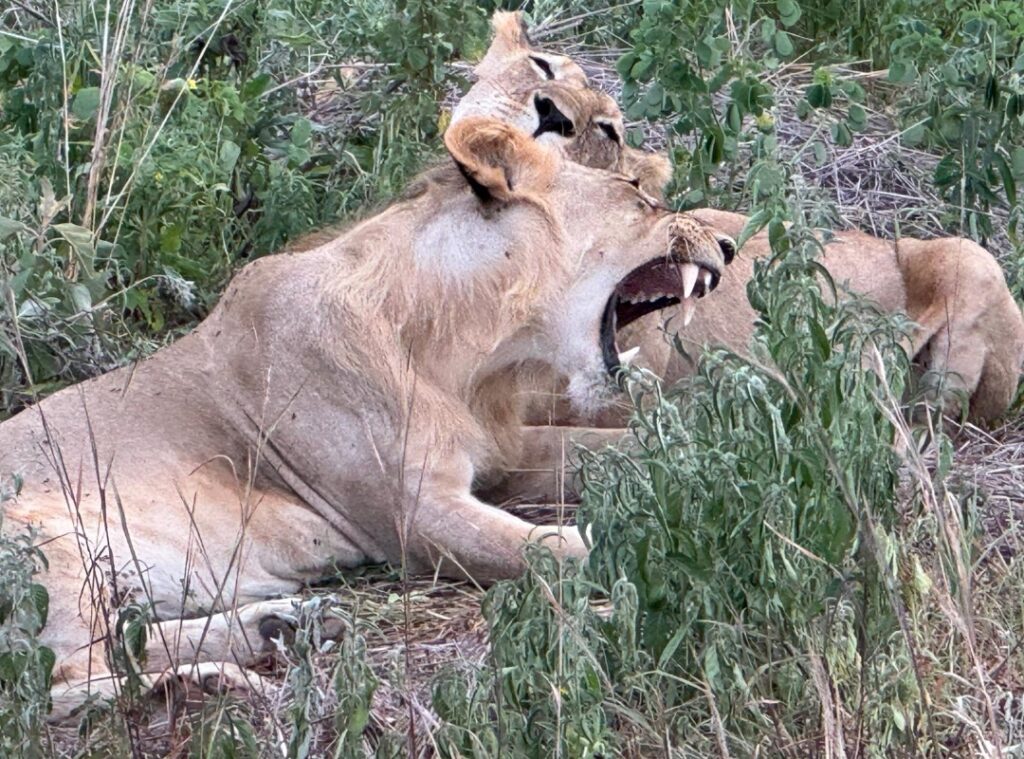
Tarangire – Lions alongside Elephants and Baobabs
Closer to Tanzania’s northern safari circuit lies Tarangire National Park, famous for its ancient baobabs, enormous elephant herds and seasonal wildlife concentrations.
But Tarangire is also an important lion habitat.
Long-term research in the Tarangire-Manyara ecosystem has monitored lions across a landscape of approximately 35,000 km². During the period covered by one long-term study, the core study population fluctuated around 160–200 lions.
Earlier demographic research in Tarangire National Park estimated approximately 155 lions in 2013, including nine prides. The study recorded pride sizes ranging from very small groups to prides of more than 30 animals.
Tarangire demonstrates an important principle of lion ecology:
Lions follow opportunity.
During the dry season, wildlife concentrates around permanent water sources and productive areas. This concentration can create excellent conditions for predators.
That is why a quiet drive along the Tarangire River or near its seasonal swamps can suddenly turn into an unforgettable lion encounter.
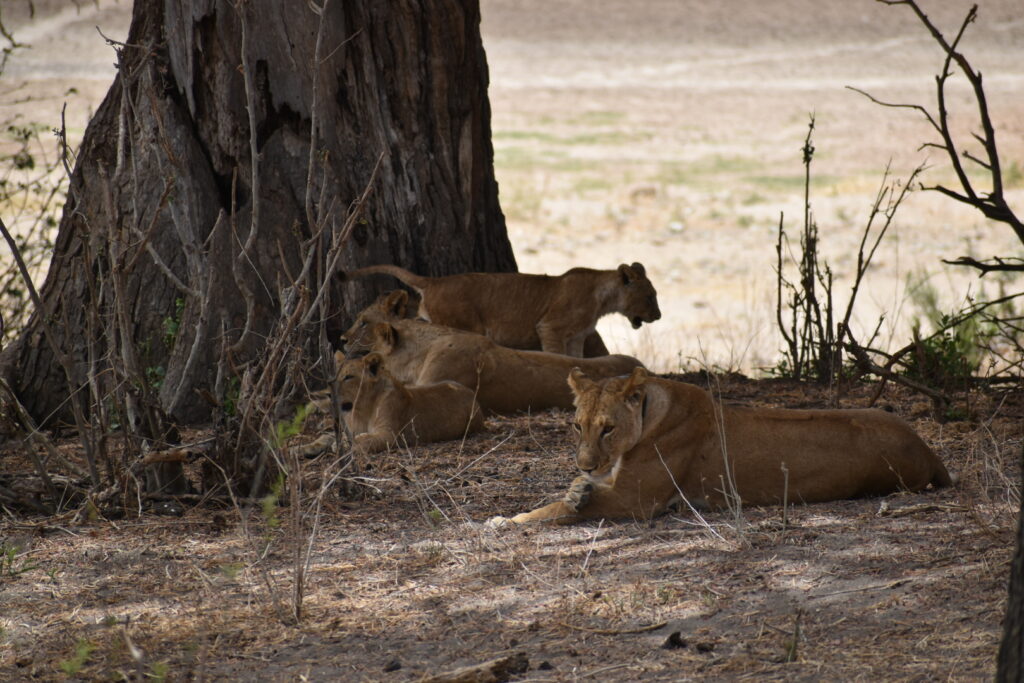
Ngorongoro Crater – A World of Lions inside a natural amphitheatre
Few places in Tanzania are as dramatic as the Ngorongoro Crater.
The crater’s enclosed landscape provides exceptional conditions for wildlife, with abundant prey and relatively limited human disturbance inside the crater itself.
For visitors, this can create spectacular opportunities to observe lions.
But there is another fascinating side to the Ngorongoro lions.
They are a remarkably isolated population.
Recent genetic research estimates that the crater population currently comprises approximately 60 lions, forming around five prides. Researchers describe the population as ecologically isolated and found evidence of limited immigration of breeding males from the surrounding Serengeti ecosystem.
That makes the Ngorongoro lions scientifically fascinating.
They represent a relatively isolated population whose genetic future is closely connected to what happens in the wider ecosystem around the crater.
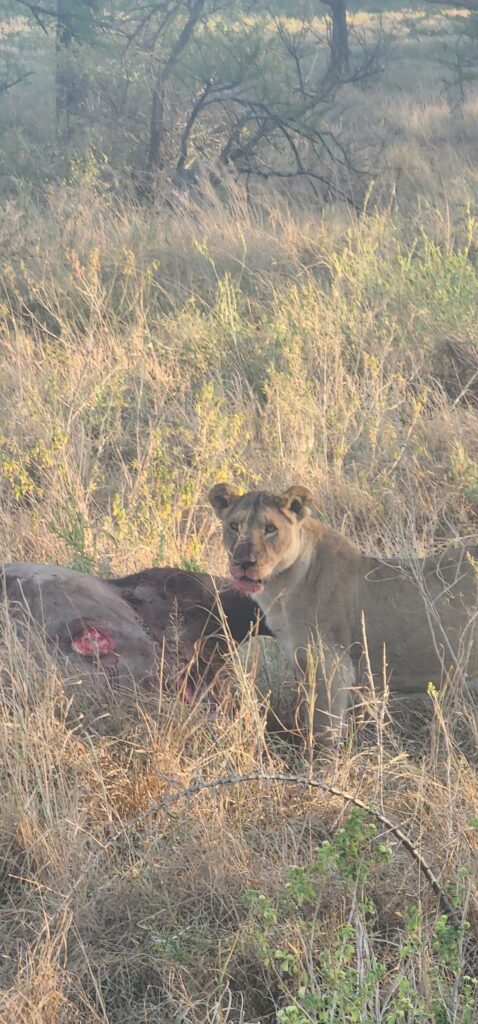
Selous-Nyerere – Lions in a vast wilderness
Further east, the enormous Selous-Nyerere ecosystem provides another important habitat for lions.
Unlike the Serengeti, this landscape receives considerably less attention from international safari visitors.
But scientifically, it is extremely important.
And there is still much to discover.
Recent research conducted across the Selous-Nyerere ecosystem used 638 camera traps covering more than 8,000 km² over three dry seasons. Researchers identified 118 individual lions and used the photographic data to estimate lion densities across seven study areas.
The results also highlighted an important conservation message:
Lion numbers are strongly connected to prey availability and human pressure.
Areas close to protected-area boundaries can face increased pressure from activities such as bushmeat poaching and intentional poisoning.
This is why protecting lions means protecting far more than lions.
It means protecting prey.
Protecting habitats.
Protecting corridors.
And finding ways for people and wildlife to coexist.
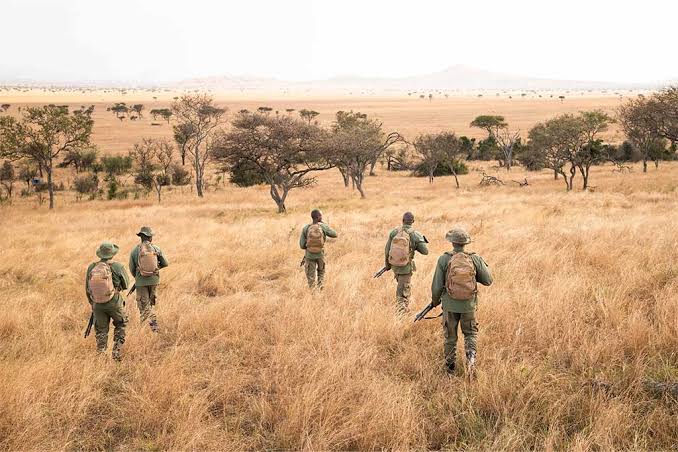
How many Lions are there in Tanzania?
This sounds like a simple question. It isn’t.
There is no single current nationwide lion census that can count every lion in Tanzania.
Lions occupy huge landscapes, cross boundaries between protected areas, game reserves and community lands, and are difficult to detect accurately.
Scientists therefore use different techniques, including:
- camera traps
- GPS collars
- individual identification
- spoor and track surveys
- call-back surveys
- distance sampling
- photographic capture-recapture methods
Different methods and survey areas naturally produce different estimates.
The best available country-level assessments nevertheless place Tanzania at the top of Africa in terms of lion numbers, with more than 8,000 lions estimated nationally in one recent scientific assessment.
But perhaps the more important question is not simply:
“How many lions are there?”
It is:
“Where are healthy lion populations still connected and able to survive?”
And that is where Tanzania becomes truly exceptional.
What makes a healthy Lion population?
A lion needs much more than a beautiful national park.
Lions need:
Prey
Buffalo, wildebeest, zebra, antelope and other herbivores provide the energy that sustains a pride.
Space
Lions have large home ranges and need extensive landscapes in which to hunt, reproduce and disperse.
Water
Water availability influences prey distribution and, consequently, lion movements.
Protection
Lions are vulnerable to human persecution, habitat loss and depletion of wild prey.
Connected ecosystems
Young males leave their natal prides and need safe landscapes in which to disperse and establish new territories.
Research in the Serengeti ecosystem has demonstrated how strongly lions respond to protection, human density, livestock and the position of protected-area boundaries. Lions tend to use better-protected areas more strongly and can move away from areas with greater human pressure.
This is why conservation cannot stop at the boundary of a national park.
The Biggest threat to Tanzania's Lions
Perhaps the greatest challenge for the future is not something that happens inside the national parks.
It happens where wildlife and people meet.
Tanzania’s lions live across enormous landscapes that also support pastoralists, farmers and livestock.
When lions kill livestock, people can suffer significant economic losses.
When people retaliate, lions can be killed.
And when wild prey populations decline because of habitat loss or illegal hunting, lions can increasingly turn to livestock.
This creates a difficult cycle.
Modern lion conservation therefore increasingly focuses on coexistence.
In the Ruaha landscape, for example, conservation organisations work directly with communities to improve livestock protection, monitor lions and reduce conflict.
The future of Tanzania’s lions will depend not only on national parks, but also on the people living alongside them.
Why Seeing a Lion in Tanzania Is So Special
A lion sighting is never guaranteed. That is part of what makes it special.
A safari is not a wildlife show where animals appear on schedule.
The lion may be somewhere beyond the next ridge.
A pride may have moved during the night.
A male may be hidden in tall grass.
Or you may turn a corner and suddenly find yourself looking into the eyes of one of Africa’s most iconic predators.
And then there is that moment.
The vehicle becomes quiet.
The lion lifts its head.
For a few seconds, the entire landscape seems to stop.
You are no longer thinking about photographs.
You are simply watching.
The King of the Savannah
Tanzania’s lions are an essential part of the country’s ecosystems.
The vast plains of the Serengeti, the rugged landscapes of Ruaha, the baobab-studded plains of Tarangire, the extraordinary isolation of the Ngorongoro Crater, Tanzania still provides some of the world’s most important habitats for wild lions.
And while researchers continue to count, track and study them, one thing is already clear:
Tanzania is one of the last great strongholds of the African lion.
So when you travel through Tanzania and see a lion resting beneath an acacia tree, remember what you are looking at.
Not simply the “King of the Jungle.”
But a highly social, intelligent and remarkably adaptable predator – living in one of the last great wilderness landscapes on Earth.
This is the wild Tanzania we travel for.
This is where the lions still roam free.
Ready to experience the wild side of Tanzania?
At Afrimine Tours, we create private and tailor-made Tanzania safaris focused on authentic wildlife experiences – from the legendary Serengeti and Ngorongoro to Tarangire and the country’s lesser-known wilderness areas.